In Video: Construction of a New Power Plant
&cropxunits=450&cropyunits=300&w=600)
Darine Al-Ali: Engineer Othman Al-Attiyah, Director of the Eastern Doha Power and Water Desalination Plant, revealed that the Ministry has formulated a long-term strategic plan to fully decommission the Eastern Doha plan
Translated by Qiyas from الأنباء — Original source
Darine Al-Ali: Engineer Othman Al-Attiyah, Director of the Eastern Doha Power and Water Desalination Plant, revealed that the Ministry has formulated a long-term strategic plan to fully decommission the Eastern Doha plant, along with the Shuaiba plant, and dismantle them in the future. A new, fully modernized plant will be constructed on the same site, with a production capacity double that of the current facility.
He clarified that the implementation of this plan coincides with the commissioning of new major national energy projects, such as the northern stages of the Al-Zour plant, the Khiran plant, and the Shagaya Renewable Energy Complex, thereby ensuring the continued stability of the national power system and preventing any deficits during the transition period.
Speaking to “Al-Anbaa,” Engineer Othman Al-Attiyah stated that the Eastern Doha plant constitutes one of the fundamental pillars of Kuwait’s power and water systems. He noted that it is among the country’s oldest power generation facilities, having commenced operations in 1977, and continues to play a pivotal role in supporting the national grid.
The plant comprises seven steam power generation units, each producing 150 megawatts, bringing the total generation capacity to 1,050 megawatts fed into the national electrical grid.
It also includes seven water desalination units, each producing 6 million imperial gallons of fresh water daily, resulting in a total output of 42 million imperial gallons of fresh water per day.
Al-Attiyah further explained that the plant is simultaneously executing a comprehensive rehabilitation project for its turbines and operational units, noting that the project has reached approximately 50% completion. The remaining work will be carried out during the upcoming winter maintenance season.
Regarding cybersecurity, he stated that the facility operates in accordance with directives from the National Cybersecurity Authority. Operational control systems have been entirely replaced with modern, advanced systems, and advanced cybersecurity protocols are being implemented to protect operational networks from any unauthorized access, breaches, or external cyberattacks.
Engineer Al-Attiyah emphasized that the Ministry’s efforts in developing and maintaining infrastructure must be accompanied by public awareness regarding the importance of conserving electricity and water consumption.
For more details: “Al-Anbaa” toured the plant’s facilities and spoke with its director and staff to convey the true picture of the efforts made to ensure the continuity of services. “Al-Anbaa” Tour at “Eastern Doha”.. Supports the Grid with 1,050 Megawatts
Darine Al-Ali: Employees at the power stations under the Ministry of Electricity, Water and Renewable Energy are considered frontline staff due to their efforts, as they work day and night to keep power units operational and ensure the uninterrupted supply of electricity and water services to the country. Their efforts became particularly evident during the recent crisis imposed by the war on the country, as well as during difficult climatic conditions. The power generation and water desalination sector operated at full capacity, with administrators, staff, and technicians working tirelessly to maintain the continuous supply of electricity to all customers, especially in light of recent events, harsh weather conditions, extreme heat, and increased pressure on the stations.
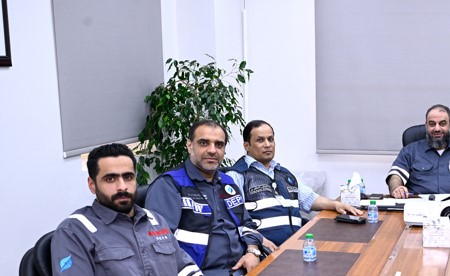
To shed light on these efforts, Al-Anbaa visited the Eastern Doha Station, toured its facilities, and spoke with its manager and employees to convey the true picture of the work being done to ensure service continuity.
At the outset, Eng. Othman Al-Otaibi, Manager of the Eastern Doha Power and Water Desalination Station, emphasized that the station represents one of the fundamental pillars of Kuwait’s electricity and water systems. He noted that it is among the country’s oldest power generation stations, having commenced operations in 1977, and continues to play a pivotal role in supporting the national grid thanks to continuous maintenance programs, technical upgrades, and advanced security measures.
He explained that the station comprises seven steam power generation units, each producing 150 megawatts, bringing the total installed capacity to 1,050 megawatts pumped into the national electricity grid. It also includes seven water desalination units, each producing 6 million imperial gallons of fresh water daily, for a total daily output of 42 million imperial gallons.
Regarding maintenance, he added that all currently operational generation and desalination units are running at full capacity, contributing effectively to meeting the national grid’s electricity and water needs. He pointed out that maintaining the station’s efficiency over the years has been the result of implementing periodic preventive and overhaul maintenance programs, alongside continuous updates to operational systems. He noted that the last maintenance cycle, prior to the summer of 2026, faced exceptional challenges imposed by regional conditions.
On digital solutions, he clarified that maintenance work on two units was delayed due to the inability of manufacturer experts to visit the site because of closed regional airspace. However, the station management overcame these challenges by applying digital solutions, carrying out maintenance through direct collaboration with manufacturers via internet connectivity and live cameras. This allowed local engineers to perform all required technical work and return the units to service at full capacity. He added that only one unit remains temporarily out of service due to delays in receiving spare parts caused by regional maritime disruptions and the closure of the strait.
He further explained that the station is simultaneously implementing a comprehensive rehabilitation project for turbines and operational units, with the completion rate reaching approximately 50% of the total project. The remaining portion will be executed during the upcoming winter maintenance season, when electricity grid loads naturally decrease. He confirmed that all spare parts and materials required for the project have already arrived in the country and are securely stored at the station, ready for the replacement program during the winter season according to the approved schedule.
Regarding cybersecurity, the station manager stated that the facility operates in accordance with directives from the National Cybersecurity Center. Operational control systems have been entirely replaced with modern, advanced systems, and advanced cybersecurity protocols are being implemented to protect operational networks from any unauthorized access, breaches, or external cyberattacks. He added that cybersecurity system development will continue in parallel with future maintenance programs to ensure long-term stability of the operational network.
He emphasized that protecting the station is not limited to the technical aspect but also includes field security. He explained that the Kuwait National Guard plays a key role in securing the facility by managing entry gates and conducting security checks for all employees and visitors, alongside the permanent presence of security personnel in main control rooms to ensure continuous operation in a safe and stable environment.
He confirmed that the station relies on national cadres from the ministry, along with several contracting companies operating under specialized maintenance and development contracts. He stressed that worker safety is a top priority, with the station implementing strict occupational safety plans supervised by specialized teams. Field inspection rounds are conducted several times daily, from the beginning to the end of shifts and around the clock for 24 hours, to monitor the work environment and ensure full compliance with safety procedures.
He clarified that the station houses one of the largest specialized training centers, which organizes an annual comprehensive program of training courses directed at employees at the station and the other six power stations. The training programs cover operations, electrical systems, precision instruments, mechanics, and industrial safety. Additionally, workshops are organized to analyze previous equipment failures and utilize the lessons learned to develop future preventive solutions. The center also hosts students from the Higher Institute of Energy annually to provide them with field and practical training within the station.
Regarding the ministry’s future plans, the station manager explained that the ministry has established a long-term strategic plan to completely decommission the Eastern Doha Station, along with the Shuwaikh Station, and dismantle them in the future. He added that after the dismantling works are completed, a new, fully modern station will be built on the same site, with a production capacity double that of the current station. He clarified that the timing of this plan is synchronized with the entry into service of new major national energy projects, such as the northern Zour power plant stages, the Al-Khiran power plant, and the Shagaya Renewable Energy Complex, ensuring the continued stability of the national electricity system and preventing any deficit during the transition period.
On the importance of conservation, the Eastern Doha Station manager concluded by emphasizing that the ministry’s efforts to develop and maintain infrastructure must be accompanied by public awareness of the importance of conserving electricity and water consumption. He noted that the Ministry of Electricity, Water and Renewable Energy launched its fourth edition of the national conservation campaign under the slogan “Save,” patronized by Minister of Electricity, Water and Renewable Energy Dr. Sabih Al-Muzayim and Deputy Minister Dr. Adel Al-Zamil, which has been ongoing since May 11. He explained that the campaign focuses on raising awareness among citizens and residents about daily practices that contribute to reducing consumption, such as adjusting air conditioner temperatures during peak hours, turning off lights and appliances in unused areas, and adhering to guidelines for calibrating electrical devices to reduce unnoticed waste.
Security, safety, maintenance, and operation: An integrated system for station continuity.
Several officials present at the tour spoke about their respective fields, highlighting how maintaining grid stability relies on an integrated system ensuring the continuous operation of the stations.
Initially, Eng. Ali Mirza, Head of the Security and Safety Department, emphasized that the Stations Sector places great importance on the security and safety system, driven by its commitment to protecting employees and preserving equipment integrity, which are the two fundamental pillars for ensuring efficient and continuous operations. Mirza clarified that equipment reliability depends on continuous monitoring of operational processes and verifying that maintenance activities and procedures adhere to approved regulations. The Security and Safety Department’s role is to protect employees from potential hazards through continuous field inspections at work sites and ensuring compliance with safety requirements according to international standards, thereby guaranteeing a safe working environment for all staff.
He noted that during the recent period, which coincided with events in the region, security and safety measures were raised to the highest levels in coordination with the National Guard, aiming to protect facilities both internally and externally. This was achieved by tightening entry and exit procedures for employees, deploying National Guard personnel inside the station alongside security and safety teams, and conducting round-the-clock inspection and patrol rounds.
He praised the cooperation shown by relevant authorities and various state ministries in overcoming obstacles and managing the circumstances the country faced, which contributed to ensuring the continuity of operations.
Station Units Undergo Three Types of Maintenance
In the area of mechanical maintenance, Eng. Ali Al-Ali, Mechanical Maintenance Supervisor, explained that station units undergo three types of maintenance: periodic, emergency, and preventive. He stated that periodic maintenance is carried out annually according to a schedule covering all units, while emergency maintenance is performed whenever a fault occurs that requires taking a unit out of service, with efforts focused on repairing it and returning it to operation as quickly as possible. He added that preventive maintenance is conducted during the annual maintenance period and includes tasks such as cleaning filters and monitoring equipment temperatures, ensuring their readiness and efficient operation in subsequent periods.
He clarified that the periodic maintenance program begins in September and continues until May, implemented in coordination with all stations to ensure uninterrupted electricity service to all customers.
All Station Units Ready for Current Season
For his part, Eng. Aid Al-Mutairi, Electrical Maintenance Supervisor, stressed the importance of electrical maintenance work in maintaining unit readiness, noting that all station units are now ready for the current season and operating at full capacity, with the final unit expected to enter service during the current month.
Al-Mutairi commended the support provided by Ministry officials, led by the Minister and Deputy Minister, in overcoming obstacles faced during maintenance operations, particularly regarding the shortage of spare parts and the recruitment of experts from abroad amid wartime conditions.
He also appreciated the efforts of workers in electrical maintenance supervision, praising their rapid response to emergency tasks and their commitment to working during the period of events, as well as their swift handling of resulting damages and quick return of affected units to service.
Coordination with National Control Center and Water Center to Monitor Operational Status
Regarding operational processes, Eng. Abdulaziz Al-Zaid, Operations Supervisor, explained that the nature of monitoring work requires staff to be on duty around the clock through a shift system, to oversee operations and ensure their safety, along with continuous coordination with other supervisory departments in the event of any faults or emergencies.
Al-Zaid noted the existence of continuous coordination with the National Control Center and the Water Center to monitor operational conditions and unit readiness, as well as coordination with other regulators to shut down units undergoing maintenance in accordance with approved schedules. He added that during the war, staff numbers were reduced to the minimum necessary to sustain operations, in line with security requirements, while maintaining the plant’s continuous operation and service efficiency.
