Al-Mutairi: Japan and Oman catch tuna using the "jag" method
&cropxunits=360&cropyunits=450&w=600)
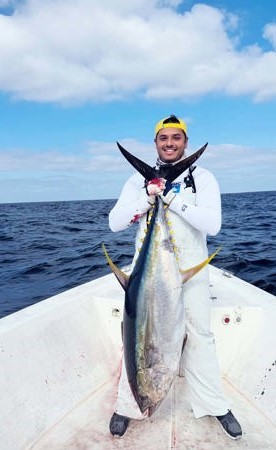
The “Bahri” page meets today with spearfisher Abdulaziz Al-Barghash Al-Mutairi, who has moved beyond treating spearfishing as a hobby to mastering it as a profession, distinguished by his expertise in various fishing techniques associated with the spear, including spearfishing using the Daffar, Jaq, and Lefah methods, as well as spearfishing for Asayef and Ghuba. He shared with us his beginnings in free diving, learning the fundamentals of diving from his father, and the timing of the Shuam and Nawabi seasons. We also discussed the fish currently available and their methods of capture, his experience spearfishing in Okinawa, Japan, to catch tuna, and his transition to spearfishing in the Sultanate of Oman. He explained what distinguishes Oman’s waters, the fishing seasons there, when the Omani tuna season begins, and the best methods for catching it. He also detailed the locations of Kuwaiti tuna and offered advice to fellow spearfishers, along with diverse information on tuna from Japan, Oman, and Kuwait. Here are the details:
At the outset, Al-Mutairi said: “My start in the sea was somewhat different. It began with my father 20 years ago, when he taught me free diving and spearfishing using a speargun in Binader, Umm Al-Ramadh, and Qarawa. Later, I moved to spearfishing for Asayef species in areas such as Kuwait Towers, Fahaheel, and Badia, primarily to catch Shuam fish. In early 2013, I embarked on a new fishing experience: the Daffar method (entering the sea at the start of the tide and gradually retracting the spear as the water rises). This technique requires knowledge of tides and the optimal tide level for catching Shuam. I use the Daffar method during the summer, from late August to late November, and in winter, from early January to late March.
“In 2014, after several attempts to catch Hamour (grouper) with a spear, I decided to try the Lefah method with a hook. I succeeded in my first catch (Lefah), and indeed, diversifying fishing methods gives you an advantage.
“Al-Joun (the northern sea) is considered the best location for hook fishing. I focus on bridges and structures made of concrete and iron, as well as rocky areas, due to the high concentration of fish around them, as these environments are suitable for them. Summer is the season when Ouma, Zoori, and Mid fish gather, and fish presence is highest. Currently, available species include Shuam, Hamour, Shem, and Naqoor, which can be caught using the Lefah or Jaq methods. For Shuam, the best fishing spots are bridges, using bait similar to oysters, Shurayb, shrimp, and small Ouma species. They are abundant from May to October. As for Nawabi fish, it is more prevalent in winter than in summer and is caught using the Jaq method in various locations, such as Dafan and Ras Al-Salmiya (Al-Rakseh).
“A 10-Day Trip to Oman
“Al-Mutairi continued: “My spearfishing experience in the sisterly Sultanate of Oman, specifically in the Masirah area, took place in 2015 with my uncle, Walid Al-Fadala. The trip lasted 10 days, involving both boat spearfishing and Asayef spearfishing. It was a very enjoyable experience, and I witnessed a great diversity of fish, including Thawr Al-Anadq, Naqoor, and Hamour, among others.
“Subsequent visits to Oman saw me increase my focus on modern fishing techniques. I learned the Fast Jaq method to target specific species like Amberjack, and I switched from light to medium spearguns to target larger fish such as Mahi-Mahi, tuna, and King Mackerel. I then moved to the Khaluf and Al-Shuwaymiyah areas, which are characterized by their proximity to islands that serve as excellent fishing spots due to the abundance and variety of fish.
“Oman Has Multiple Seasons
“Al-Mutairi added: “Oman has multiple seasons, depending on the target species. From September to November is the prime season, as wind speeds are moderate and most fish species are available. January to May is the season for Yellowfin tuna, particularly in areas such as Al-Shuwaymiyah, Masirah, Muscat, and others.
“Tuna from Japan and Oman
“Al-Mutairi said: “My initial experience with tuna was specifically in Japan, on Okinawa Island. Japan is renowned for its tuna, and I relied on modern fishing methods (Jaq), as it was the common technique for catching them. The trip lasted three days, filled with fun and adventure, and introduced me to the world of large fish (‘Baq Qeem’). After this experience, I prepared specialized gear for tuna fishing, with one of my goals being to catch Omani tuna upon my return from Japan. I transitioned from light and medium spearguns to heavy ones, weighing between 140g and 230g, and used reels of size 14,000 or larger, employing surface lures such as poppers and stick baits to target tuna on the water’s surface.
“Fishing for Tuna is Worth the Effort
“Al-Mutairi added: “After returning from Japan, I traveled to the Sultanate of Oman between February and March, specifically to the Al-Shuwaymiyah area, targeting Yellowfin tuna. I succeeded in catching large specimens during a trip that was both very exhausting and enjoyable. Tuna are known for their physical strength and speed. I now understand why they are called ‘stubborn Yellowfin tuna,’ as they require significant time and effort to catch. The feeling of catching them truly makes the effort worthwhile. My latest tuna experience involved Kuwaiti tuna, specifically the ‘Longtail Tuna’ variety, caught between October and March using medium gear. They are usually found in the southern waters between Kuwait and Saudi Arabia in territorial waters. I consider this particular tuna precious because it is a Kuwaiti species and can be caught in Kuwaiti waters.
“Closing Remarks
“Al-Mutairi concluded: “My advice to fellow spearfishers is to maintain the cleanliness of Kuwaiti waters and to use a fixed trash bin on the boat. Also, limit catches to specific quantities and sizes, and release small fish back into the sea. Additionally, prepare a first-aid kit and essential equipment on the boat, such as a fire extinguisher and life jackets, in case of emergencies. I would like to thank the Coast Guard for their significant efforts in ensuring maritime security, providing assistance to all users, and protecting sea enthusiasts. May God protect everyone.”
