Completion of the membership of the new Syrian People's Council following the announcement of the presidential list and its first session next Monday
&cropxunits=450&cropyunits=258&w=770)
The Supreme Committee for People’s Council Elections announced yesterday the names of the 70-member third of the council appointed by President Ahmed al-Sharaa, in accordance with the Constitutional Declaration, to compl
Translated by Qiyas from الأنباء — Original source
The Supreme Committee for People’s Council Elections announced yesterday the names of the 70-member third of the council appointed by President Ahmed al-Sharaa, in accordance with the Constitutional Declaration, to complete the council’s membership, except for As-Suwayda Governorate, where elections were not held.
Among the appointed members are survivors of the former regime’s prisons and former members of the National Coalition opposition, including prominent Druze politician Layth al-Balous, as well as 15 women, including young actress Rozina al-Ladhiqani.
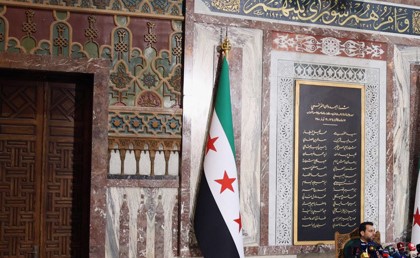
The committee’s chairman, Muhammad Taha al-Ahmad, read out the names of the People’s Council members, including the supplementary third, during a press conference at the council’s headquarters in Damascus. With the announcement of the supplementary third, the council is now able to convene. Al-Ahmad specified during the conference that Monday, July 6, 2026, has been set as the date for the first session, which will include the swearing-in of all members, the election of the presidential bureau, and the formation of a special committee to draft the council’s internal regulations.
During the conference, the committee chairman also read out Decree No. (143) of 2026, issued by the Syrian President, which includes the names of the People’s Council members who won their seats and were previously announced by the Supreme Committee for Elections, as well as the names of the supplementary third appointed by al-Sharaa.
Al-Ahmad stated that, according to the Constitutional Declaration, the term of the People’s Council is two and a half years (30 months), subject to extension.
Regarding the backgrounds, distribution, and diversity of the appointed members, the People’s Council’s Secretary-General, Muhammad Hamza Shamout, clarified that the supplementary third is composed of 55 men and 15 women, including five members with disabilities who were injured during the war and 13 former detainees in the prisons of the ousted regime.
The members are categorized into 23 prominent figures and 47 experts, including 12 with master’s degrees and 17 with doctoral degrees. Geographically, they are distributed as follows: 5 from Idlib, 6 from Homs, 7 from Al-Hasakah, 4 from Daraa, 3 from Raqqa, 5 from Damascus, 2 from Quneitra, 6 from Deir ez-Zor, 4 from Latakia, 5 from Rural Damascus, 14 from Aleppo, 2 from Tartous, 5 from Hama, and 2 from As-Suwayda.
Speaking at the press conference, al-Ahmad said that the list of appointed members was formed with consideration for including exemplary representatives of the nation, including relatives of martyrs, survivors of detention centers, and survivors of chemical attacks, alongside a select group of academics, experts, qualified professionals, community leaders, and well-known national figures distinguished by their experience, integrity, and service to public affairs.
In response to journalists’ questions, the chairman of the Supreme Committee for People’s Council Elections affirmed that the council would begin its duties by holding its first session next Monday, and would play a pivotal legislative role during the transitional phase. This role includes reviewing previous decrees, approving laws and regulations necessary for the next stage, and forming a committee to draft a new constitution. He emphasized that the selection of the supplementary third was based on competence and experience, and aimed to represent categories that had made sacrifices, free from sectarian or ethnic quota-based allocation.
Al-Ahmad explained that the council’s priorities include updating laws, approving legislation related to workers, wages, and investments, as well as forming a committee to draft a new constitution that takes into account Syria’s conditions and the aspirations of Syrians.
He stated that the council has the authority to propose draft laws through its specialized committees, discuss projects submitted by the executive branch, and hold hearing sessions with executive officials, while other bodies are responsible for accountability procedures based on the council’s recommendations.
Regarding parliamentary immunity, al-Ahmad clarified that it is limited to protecting members of the People’s Council while performing their duties and does not exempt them from legal accountability. He noted that the delay in announcing the supplementary third list was due to renovation and preparation work at the People’s Council building, as well as the desire to ensure balanced representation of Syria’s diverse societal components.
Al-Ahmad indicated that elections in As-Suwayda Governorate were postponed due to current circumstances, with the guarantee that its representation would be included in the supplementary third. Elections in the governorate will be held when suitable conditions arise. He reiterated that the selection of the supplementary third was not based on quotas, but on competence and experience, while ensuring representation for relatives of martyrs, the injured, prison survivors, and women. He stressed that the Kurdish component is an indigenous part of Syrian society, and that selection criteria relied on national qualifications rather than demographic proportions.
