The Gulf Cooperation Council-Kuwait-US Ministerial Meeting discusses enhancing security and stability and ensuring the achievement of a comprehensive peace agreement in implementation of the US-Iran memorandum of understanding
&cropxunits=450&cropyunits=300&w=770)
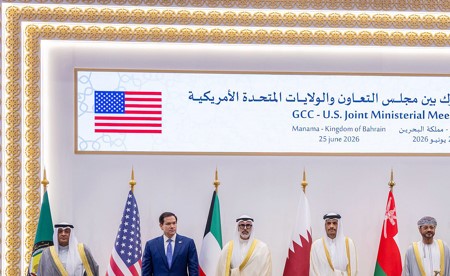
The joint ministerial meeting between the Gulf Cooperation Council (GCC) states and the United States of America was held yesterday in the Bahraini capital, Manama. The Kuwaiti delegation participating in the meeting was
Translated by Qiyas from الأنباء — Original source
The joint ministerial meeting between the Gulf Cooperation Council (GCC) states and the United States of America was held yesterday in the Bahraini capital, Manama. The Kuwaiti delegation participating in the meeting was led by Foreign Minister Sheikh Jara Al-Jaber.
The meeting was chaired by Dr. Abdul Latif bin Rashid Al Zayani, Bahrain’s Minister of Foreign Affairs and President of the current GCC Ministerial Council session, alongside US Secretary of State Marco Rubio. Also present and participating were Sheikh Mohammed bin Abdulrahman bin Jassim Al Thani, Qatar’s Prime Minister and Minister of Foreign Affairs; Saudi Arabia’s Foreign Minister, Prince Faisal bin Farhan; Oman’s Foreign Minister, Badr Al Busaidi; UAE Minister of State for Foreign Affairs, Lana Nuseibeh; and GCC Secretary-General Jassem Al-Bedaiwi.
In a statement, the Foreign Ministry noted that the GCC and US foreign ministers reaffirmed the robust, long-standing relationship between the GCC states and the United States, as well as the historical friendship ties between the two sides. They discussed ways to enhance Gulf-US relations and expand partnership areas to broader and more comprehensive horizons.
The ministry added that the meeting reviewed the latest regional developments, particularly diplomatic efforts to enhance security and stability in the region following the signing of a memorandum of understanding (MoU) between the United States and Iran. Discussions covered regional developments and the US administration’s efforts to complete negotiations with Iran to ensure a comprehensive peace agreement, in implementation of the MoU signed between the US and Iran. This aims to end military operations on all fronts, reopen the Strait of Hormuz to international navigation, and ensure regional security and stability.
Both sides emphasized the necessity of maintaining momentum and a unified position while negotiations continue, aiming for a more permanent cessation of hostilities and achieving the shared goal of preventing Iran from developing or acquiring nuclear weapons in any form. The ministers also welcomed the reopening of the Strait of Hormuz, affirming that free, unconditional, and unrestricted navigation remains a fundamental element of regional and international security. The two sides also discussed regional issues, including the situations in Syria, Lebanon, and Gaza.
Bahrain’s Foreign Minister stressed that the security of Gulf states constitutes an integrated system that cannot be fragmented or divided, and that maintaining it requires continued joint work and constant coordination among sister and allied nations. This was stated in a speech delivered by Al Zayani while chairing the joint ministerial meeting. He emphasized that the region is at a critical juncture requiring intensified cooperation and coordination to address current challenges and enhance security and stability, noting that this period is crucial for the region.
Al Zayani explained that recent attacks on the region by Iran constituted a real test, but they proved the resilience and strength of Gulf states’ institutions and societies, as well as their ability to handle various challenges efficiently and competently. He stressed: “This experience has strengthened our resolve that such attacks must not become commonplace, and that we must continue working with our partners to consolidate the foundations of peace, security, and lasting stability for future generations.”
He pointed to a glimmer of hope for the region in light of the MoU signed between the United States and Iran, mediated by Pakistan and Qatar, emphasizing the importance of Iran’s commitment to fulfilling all its pledges and obligations to contribute to consolidating regional security and stability. He welcomed Oman’s announcement regarding a safe passage for ships in the Strait of Hormuz, considering this step a positive contribution to ensuring freedom of maritime navigation and protecting international trade movements.
He further clarified that the meeting addressed several important regional files, foremost among them supporting the sovereignty and stability of Syria and Lebanon to enhance security and development in the region, and advancing and strengthening peace in Gaza. He affirmed that GCC states look forward to a new phase in the region based on respecting state sovereignty, adhering to international law, and enhancing regional cooperation to achieve the aspirations of the region’s peoples for security, stability, and sustainable development.
For his part, the US Secretary of State said that Washington has worked with GCC states for decades on a variety of issues, all driven by a shared goal of enhancing stability, security, and prosperity. He noted that “this alliance has undergone a real test in light of recent events, and it has passed this test with great success,” adding that the level of cooperation, coordination, and friendship that united them during these difficult times was tested and proved its strength and resilience.
He affirmed that any agreement reached with Iran “would not conflict with the interests of our partners in the region.” Speaking at the meeting, he said the interests of our partners in the region must be taken into account in any agreement, emphasizing that any decisions made in talks with Iran would safeguard the interests of our allies in the region. He pointed out that US President Donald Trump has affirmed his openness to peace that ensures the security and prosperity of the United States and Gulf states.
He stated that Iran will not possess nuclear weapons, and that any agreement we enter into must clearly ensure this does not happen, including verifiable measures that can be implemented and monitored.
In a press statement after the meeting, the US Secretary of State said: “I came to the region to reassure our partners that we will not agree to any action that undermines their security or poses a threat to them.” He added in Manama, the final stop on a Gulf tour that included Abu Dhabi and Kuwait: “We reject paying any money for passage through the Strait of Hormuz, regardless of the name or method of payment, and we will not tolerate this.” He said: “I affirmed in my meetings with Gulf states what President Trump stated: there are no fees for transiting the Strait of Hormuz,” noting that “Gulf states do not support imposing any fees on waterways, and we will coordinate with them on every step regarding Iran.”
While affirming that “we did not discuss with Gulf states the issue of creating a reconstruction fund,” Rubio stressed that “the memorandum of understanding is not a comprehensive agreement but rather sets out the broad outlines for negotiations.” He continued that Iran funds several groups, such as Hezbollah in Lebanon and the Houthis in Yemen, thereby interfering in the affairs of these countries, and there will be no peace and stability in the region with the presence of its proxies. He noted that “several countries have offered assistance to free the stranded sailors.”
For his part, the GCC Secretary-General said the meeting discussed many files, foremost among them the situation in the region and ways to enhance its security and stability, as well as de-escalation and mediation efforts. He mentioned that during the meeting, it was reaffirmed that any future understandings or arrangements must include the requirements of GCC states to safeguard their interests and ensure their security and stability, and must be based on the principles of international law, respect for state sovereignty, good neighborliness, and non-interference in internal affairs, contributing to consolidating regional security and stability.
Al-Bedaiwi affirmed that GCC states welcomed during the meeting all diplomatic efforts that contribute to de-escalation and enhance security and stability in the region, and ensure the security of sea lanes, including the Strait of Hormuz, freedom of navigation, and respect for international law rules, achieving security and prosperity for the peoples of the region and the world.
For his part, Omani Foreign Minister Badr Al Busaidi renewed Oman’s support for the MoU signed between the United States and Iran and the importance of succeeding in its objectives to achieve the desired peace, emphasizing Oman’s commitment to full and constructive engagement with various parties to advance this process. He also affirmed the importance of restoring freedom of navigation through the Strait of Hormuz and ensuring its safe flow, noting that Oman, as a coastal state of the strait, bears a special responsibility in supporting international efforts to secure maritime navigation in accordance with its responsibilities and obligations under international law and the UN Convention on the Law of the Sea, affirming that future arrangements concerning the strait do not involve imposing any fees for passage.
