Kuwait: Necessity to counter any violations affecting freedom of navigation and security of international sea lanes
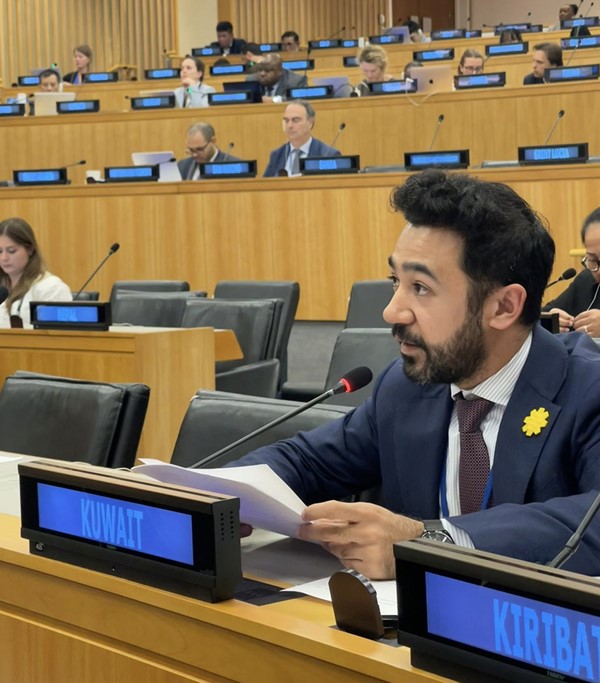
Kuwait emphasized the necessity of respecting the UN Convention on the Law of the Sea and countering any violations affecting the security of international sea lanes.
Translated by Alqyas from Al-Anba — Original source
Kuwait has affirmed the importance of the full implementation of the United Nations Convention on the Law of the Sea (UNCLOS) and respect for its provisions, considering it the comprehensive legal framework governing the uses of the seas and oceans, as well as the rights and obligations of states. It called for preserving the integrity of this legal system and strengthening the rule of international law.
This was stated in a speech delivered by Jasem Al-Ameri, Second Secretary of Kuwait’s Permanent Mission to the United Nations, during the 36th session of the Meeting of States Parties to UNCLOS, under the agenda item concerning reports by the UN Secretary-General pursuant to Article 319 of the Convention.
Al-Ameri noted that the Convention, which entered into force 32 years ago, represents one of the most important sources of international maritime law and enjoys broad acceptance within the international community, with 174 of the 193 UN member states being parties to it.
He pointed out that the ongoing armed conflicts and regional tensions worldwide underscore the importance of the effective application of the Convention and the need to address any violations affecting freedom of navigation and the security of international sea lanes. He emphasized the necessity of preventing vital waterways from being turned into tools for political pressure or arenas for conflict. He considered freedom of navigation and transit in international straits and waterways as fundamental rights enshrined in the Convention, calling on all states to fully comply with its provisions and the principles of international law.
In this context, the Second Secretary expressed Kuwait’s welcome for the agreement reached between the United States and Iran regarding a memorandum of understanding to halt military operations, describing it as a positive step toward de-escalating tensions and creating space for diplomatic solutions. He reiterated Kuwait’s commitment to Part III of the Convention, particularly Article 37 concerning the regime of transit passage in straits used for international navigation, due to its critical role in ensuring the security and stability of global maritime traffic. Al-Ameri highlighted that the security of international sea lanes is directly linked to global trade, supply chains, and energy security, calling for respect for existing legal agreements and arrangements between states and the resolution of disputes through dialogue and good faith.
He also expressed Kuwait’s concern over unilateral measures taken by Iraq regarding the 2012 Agreement on the Regulation of Maritime Navigation in the Shatt al-Arab and the cancellation of the 2008 Security Exchange Protocol, affirming that these steps contradict the principles of good neighborliness and international obligations.
Furthermore, he conveyed Kuwait’s objection and protest against a list of geographical coordinates and a map submitted by Iraq to the United Nations in January and February 2026, which included claims regarding Iraqi maritime areas, asserting that these actions infringe upon Kuwait’s rights and sovereignty over its maritime zones and violate the provisions of UNCLOS, especially amid ongoing technical and legal negotiations between the two countries to demarcate their maritime boundary. He stressed that respecting and implementing the Convention in good faith forms the foundation for preventing conflicts and enhancing security and stability in the seas and oceans, noting that preserving this legal framework is a collective responsibility incumbent upon all states.
