83.2 Billion Dinars in Financing Portfolios for Banks... 80.4 Billion Dinars in Deposit Base
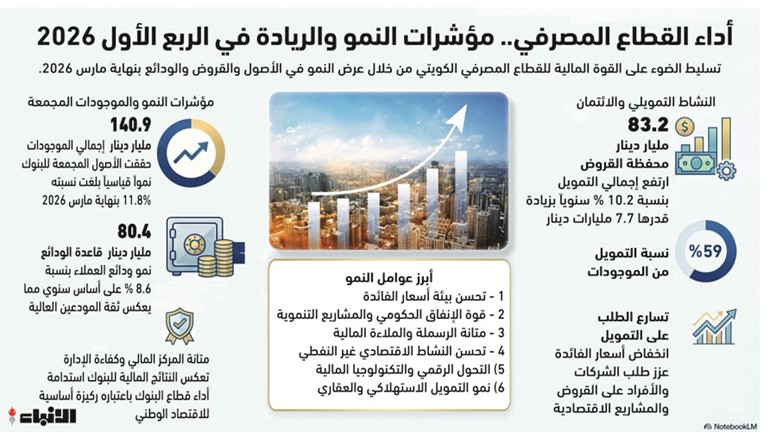
A report on the performance of the Kuwaiti banking sector in the first quarter of 2026, showing financing portfolios reached 83.2 billion dinars and the deposit base 80.4 billion dinars, with notable growth in major banks such as National Bank and Kuwait Finance House.
Translated by Alqyas from Al-Anba — Original source
The Kuwaiti banking sector continues to affirm its position as one of the most robust and stable economic sectors in the region, benefiting from the strength of its regulatory and financial environment and its ability to adapt to various economic, regional, and international developments. The performance of banks during the first quarter of the year reflected sustained momentum in banking activity, driven by rising demand for financing and the expansion of economic and investment activities, thereby reinforcing the role of the banking system in supporting economic growth and providing the necessary liquidity for various sectors.
This performance holds particular significance given the regional environment characterized by heightened geopolitical tensions during the last month of the first quarter, especially with the escalating repercussions of the military confrontation between the United States and Israel on one side and Iran on the other, along with associated concerns regarding their potential impact on financial and investment markets and regional trade flows. However, banking indicators showed that the Kuwaiti banking sector maintained its growth trajectory and continued credit expansion without recording significant impacts on financing activities, reflecting the strong financial positions of local banks and their ability to continue supporting the economy even during times of uncertainty.
Developments indicate that demand for financing remained supported by the continuous implementation of economic and developmental projects, alongside the expansion of private sector activities and rising financing needs of companies and individuals. Monetary policy trends and declining interest rate levels compared to previous periods helped enhance the attractiveness of borrowing and stimulate economic activity, which was reflected in the growth of banks’ financing portfolios and the continued flow of credit to various productive and consumer sectors.
Conversely, banks continued to strengthen their funding bases by attracting more deposits and diversifying funding sources, which provided comfortable liquidity levels and enabled them to continue expanding lending while maintaining strong financial indicators. This confirms that the Kuwaiti banking system continues to play its traditional role as a primary driver of economic activity and a key channel for financing investments and projects, as well as its role in supporting the country’s development and economic expansion plans.
These results highlight the banking sector’s ability to operate efficiently in an environment marked by challenges and rapid changes, as Kuwaiti banks have demonstrated high resilience in risk management, preserving asset quality and sustainable growth. They also reflect increased confidence among customers and investors in local banking institutions, which is a crucial factor in supporting financial stability and enhancing the Kuwaiti economy’s capacity to achieve sustainable growth rates in the coming period.
Technically, the aggregate financing portfolio of the banking sector slightly exceeded the customer deposit base, reflecting higher efficiency in liquidity utilization and banks’ benefit from diverse available funding sources. Meanwhile, the loan portfolio remained below the total deposit base, indicating that the sector continues to enjoy comfortable liquidity levels and a strong capacity to support credit growth.
Details of the financial position of Kuwaiti banks as of the end of March 2026 show that total assets of banks at the end of March 2026 amounted to approximately 14.09 billion dinars, representing an 11.8% annual growth rate. National Bank of Kuwait’s assets reached 4.61 billion dinars, accounting for 32.7% of the banks’ total asset base, with an annual growth rate of 10.7%. Meanwhile, Kuwait Finance House’s asset base at the end of March 2026 amounted to approximately 4.346 billion dinars, having increased
Assets grew by 18.2% on an annual basis, accounting for 31% of the total assets of the banking sector. Boubyan Bank’s assets reached 10.4 billion dinars, with an annual growth rate of 6.6%, while Al-Burhan Bank and Gulf Bank recorded assets of 9.53 billion and 8 billion dinars, respectively, with annual growth rates of 10.5% and 8%.
Loan Portfolio
Regarding the loan portfolio and financing receivables, the total financing portfolio of the banking sector reached approximately 83.2 billion dinars at the end of March 2026 (representing 59% of sector assets allocated to loans), up by 10.2% on an annual basis, equivalent to a value increase of 7.7 billion dinars. Notably, growth rates accelerated due to recent interest rate cuts and increased demand for financing for economic projects, the private sector, individuals, and consumer financing.
National Bank of Kuwait continued to lead with the largest loan portfolio, reaching 27.3 billion dinars at the end of March 2026, with an annual growth rate of 10.9%, representing 32.8% of the banking sector’s loan portfolio. Kuwait Finance House recorded financing receivables of approximately 21.83 billion dinars, rising by 13.2% on an annual basis and accounting for 26.2% of the total financing portfolio of the banking sector.
Boubyan Bank’s financing receivables portfolio reached 7.82 billion dinars, with a growth rate of 7.5% compared to the end of March 2025, reflecting continuous growth in recent years. Gulf Bank’s loan portfolio amounted to approximately 6.2 billion dinars, recording an annual increase of 10%. Meanwhile, the highest growth was recorded by Kuwait International Bank (KIB)’s loan portfolio, which rose by 16.8% to reach 3.37 billion dinars.
Regarding the banks’ funding base, represented by customer deposits, the total reached approximately 80.4 billion dinars at the end of March 2026, with an annual growth rate of 8.6% compared to the end of March 2025. National Bank of Kuwait led in customer deposits, reaching 25.9 billion dinars, up by 10% in the first quarter of 2026 and on an annual basis. Kuwait Finance House’s customer deposits amounted to 21.44 billion dinars, rising by 10.1%. Boubyan Bank maintained a customer deposit base of approximately 8.24 billion dinars, with an annual growth rate of 4.5%. Gulf Bank’s customer deposits reached 5 billion dinars, with a growth rate of 11%, while Al-Burhan Bank’s customer deposits stood at 6 billion dinars, up by 12.6%.
The total deposit base, which includes customer deposits as well as deposits with banks and financial institutions, reached 111.3 billion dinars for the banking sector at the end of March 2026, up by 11% on an annual basis.
