Aoun: No Other Way to Solve the Problem and Save What Remains Except Through Negotiations and Diplomacy; Peace: Lebanon Is Not a Card on Anyone's Table, and We Were Surprised by the IRGC as the First to Reject the Ceasefire
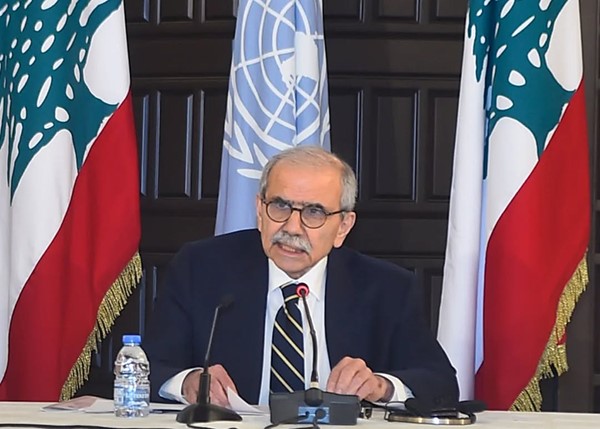
Details of negotiations, rejection of using Lebanon as a bargaining chip, and military operations in the south.
Translated by Alqyas from Al-Anba — Original source
The fires of war have overshadowed the clear skies of June, marking the beginning of summer in Lebanon, as positions emerged from the three presidential institutions—the Presidency, the Parliament, and the Government—regarding the ceasefire agreement announced by the US State Department following the fourth round of Lebanese-Israeli negotiations.
In an exclusive interview with the American CNN network, Lebanese President Joseph Aoun sent a message to Iran, emphasizing his firm rejection of any interference in Lebanese affairs. During the interview, conducted by Christiane Amanpour, Aoun also rejected the use of Lebanon as a “bargaining chip” in negotiations with the United States. Addressing Iran, he stated, “This is not your country, but ours,” adding, “They are using Lebanon as a bargaining chip in their negotiations with the United States.”
For his part, Prime Minister Nawaf Salam said, “We have chosen the path of negotiation, as it is the least costly option for Lebanon and its people, and the shortest route to ensuring Israel’s withdrawal and the return of people to their homes.” Salam also addressed Iran, saying, “Have mercy on our south; we are the owners of our homeland. Lebanon is not a card on anyone’s table, and the south is not a reserve front for anyone.”
The Prime Minister, speaking at a press conference launching the second urgent humanitarian appeal at the Sraiyeh (Prime Minister’s Office), noted that “Lebanese were surprised to see the Revolutionary Guard as the first to reject the ceasefire” announced by Washington. He added that “our plan, through the Supreme Relief Committee, includes one million displaced persons in cash assistance and 50,000 of our steadfast residents in the south,” addressing them by saying, “Your dignified and safe return to your land is at the core of our responsibility and priorities.”
Salam called on ambassadors of donor countries and representatives of UN organizations to pressure Israel to halt its attacks on civilians and stop the destruction of towns in Mount Lebanon by bulldozing homes and villages from Sidon to Bint Jbeil and Nabatieh.
The conference, attended by ambassadors of donor countries and representatives of international organizations and UN agencies, aims to secure additional funding of $331.5 million to support Lebanon, benefiting 1.4 million people. This brings the total funding required under the urgent appeal to $639.9 million by the end of this month.
The position of Parliament Speaker Nabih Berri regarding the ceasefire agreement also emerged. In a statement, he clarified that the ceasefire must be understood as complete and comprehensive, without conditions, on land, sea, and air, and without bulldozing or demolishing existing structures. He announced his agreement with “Hezbollah’s withdrawal from south of the Litani River, parallel to Israel’s withdrawal from the areas it occupied.”
Former Prime Minister Najib Mikati took a different stance, calling for “adherence to the fundamental constants announced by the President of the Republic since the beginning of the negotiation phase: a ceasefire, an end to the systematic destruction of Lebanese villages and towns, Israel’s complete withdrawal from occupied Lebanese territories, and the return of displaced persons to their towns and villages, coinciding with the implementation of the army’s deployment plan in Lebanese towns and the state’s monopoly on weapons.”
Speaking to visitors in Tripoli, he said, “These provisions collectively represent a comprehensive roadmap for the desired solution, and they can certainly form a point of consensus and support for the majority of Lebanese. However, talk of fragmented steps and understandings that do not respect known constants would exacerbate the crisis and deepen internal divisions, which is extremely dangerous. From this perspective, I call on everyone to stop the emotions that deepen divisions and ignite the already divided street, which is mired in disputes unprecedented in Lebanon’s history.”
Meanwhile, during his stay in France, MP Simon Abi Ramia met with Boris Vallaud, head of the Socialist Party’s parliamentary group, who raised the Lebanon file during his meeting with French Prime Minister Sébastien Lecornu. Vallaud asked the Prime Minister about the crimes being committed by Israel in Lebanon and the possibility of freezing the EU-Israel Partnership Agreement, calling on Paris to “intensify pressure on Israel and ensure the continuation of the UNIFIL mission.”
In his response, the French Prime Minister affirmed his country’s “commitment to respecting the ceasefire and the necessity of ending the Israeli occupation of Lebanese territories,” emphasizing “France’s support for the Lebanese state and the Lebanese Army, and efforts to renew UNIFIL’s mandate.” He also announced an increase in humanitarian and military aid to Lebanon, reaffirming “the continuation of French pressure on the Israeli government,” while postponing a final decision on the EU-Israel Partnership Agreement to the coming days.
In the meantime, Beirut ended Thursday evening amid a security incident that nearly escalated, but was contained following the intervention of an army unit. The army command issued a statement confirming that “an incident occurred in the Aisha Bakkar area in Beirut due to prior disputes, involving gunfire that injured three people, one of them in critical condition.” The statement added that an army patrol arrived at the scene, contained the incident, arrested several suspects, and seized a quantity of light and medium weapons and military ammunition.
On the ground, hostilities did not remain confined to the South. The Israeli army issued new evacuation orders for several villages and towns, confusing residents who fled. Low-flying drones continued to fly over Beirut, while Israeli fighter jets launched an airstrike on Dhour el Choueir. An enemy drone targeted a motorcycle on the Bir el Asloun-Kfar Kifra road in the Bint Jbeil district, and another struck the town of Kafr Rumman, killing two people.
The Israeli air force carried out several airstrikes on various villages and towns, including Al Marwaniya, Al Babiliya, Deir el Zharani, Kaoutariya Al Sayyad in the Sidon-Zahrani district, and Kasrati Al Arush in the Mount Lebanon heights. It also struck the Houss area in Sidon, coinciding with artillery shelling targeting the outskirts of the towns of Froun and Al Ghendouria.
The Israeli air force also bombed the Al-Tarmasa area, located between the towns of Tair Debba and Ma’arke, and killed Mohamad Munir Al Maqdam, a scout and medic from the Islamic Guide Corps (Kashafat Al Risala Al Islamiya) from Zebdine. He was killed in an airstrike carried out by enemy aircraft that targeted him and a medical team while they were delivering bread to a besieged family in Zebdine. Also killed in the strike were Qasim Maatouk, Raja Muntash, and Hassan Maatouk. Mohamad Maatouk was injured, and ambulance teams, accompanied by the army, transported him to hospitals in Nabatieh.
An enemy drone targeted a motorcycle near the official school in the town of Abba, killing two Syrians aged no more than 15 who were with their father on the motorcycle; their father was injured. The enemy air force also bombed the towns of Mifdoun and Kafr Binnet, and an Israeli drone struck the city of Nabatieh.
