Kuwaitis and expatriates spend 890 million dinars on credit card debt
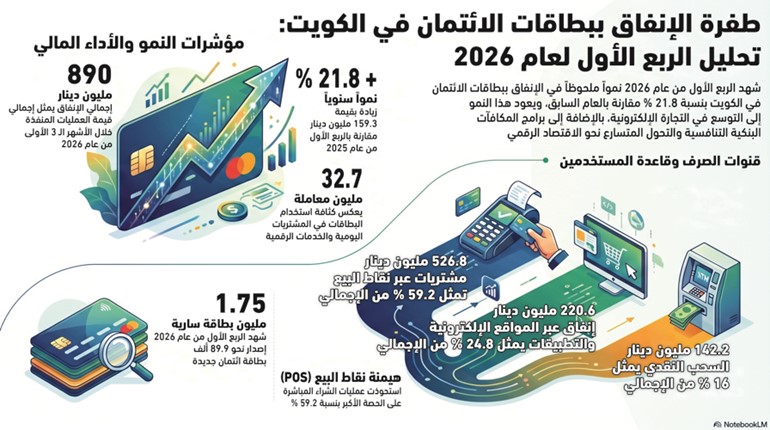
Spending via credit cards rose to 890 million dinars in the first quarter of 2026, with a 21.8% growth compared to 2025.
Translated by Alqyas from Al-Anba — Original source
Ahmed Maghrabi: Credit card spending (VISA - MASTER) in Kuwait during the first quarter of 2026 reached high levels, driven by the expanded use of electronic payment methods and increased reliance on digital purchases and online shopping. At the same time, local banks continued to enhance credit card benefits through cashback programs, rewards, travel services, and installment plans, amid intensifying competition to attract customers and boost the use of digital banking solutions.
Data from the Central Bank of Kuwait showed that total credit card spending within Kuwait in “debit” mode during the first three months of 2026 amounted to approximately 890 million dinars, distributed as 317.5 million dinars in January, 289 million dinars in February, and 283.5 million dinars in March.
Credit card spending during the first quarter of 2026 was distributed among approximately 526.8 million dinars at point-of-sale (POS) terminals, representing about 59.2% of total spending, alongside approximately 142.2 million dinars for cash withdrawals, accounting for 16%, while spending via websites and digital apps reached about 220.6 million dinars, equivalent to 24.8% of total spending recorded during the period.
According to the data, POS purchases accounted for the largest share of credit card usage, driven by rising consumer spending in the local market, while electronic spending continued to register high levels amid the expansion of e-commerce and increased reliance on digital apps and online purchasing services.
The number of credit card transactions during the first quarter of the current year also exceeded 32.7 million transactions, including POS purchases, cash withdrawals, and electronic payments via various websites and applications, reflecting the ongoing rapid shift toward digital payments in the Kuwaiti market.
Compared to the same period in 2025, the data indicates notable growth in spending volume, with total credit card spending during the first quarter of 2025 reaching approximately 730.7 million dinars, compared to 890 million dinars in the first quarter of 2026, an increase of about 159.3 million dinars, representing a growth rate of approximately 21.8%.
Meanwhile, the number of active credit cards in Kuwait rose to approximately 1.755 million cards by the end of March 2026, compared to about 1.727 million cards by the end of December 2025, an increase of approximately 28,500 cards during the first quarter of the current year, reflecting the continued expansion of the credit card user base in Kuwait.
Data from the Central Bank also showed that local banks issued approximately 89,900 new credit cards during the first three months of 2026, distributed as 36,000 cards in January, 31,900 in February, and 22,000 in March.
This growth reflects the ongoing shift toward the digital economy and the rising reliance on electronic payments in Kuwait, whether for daily shopping, bookings, travel, or digital services, alongside the significant expansion of e-commerce in recent years.
The figures also show the growing use of credit cards compared to debit cards in several consumer activities, particularly as a wide segment of customers seeks to take advantage of the additional benefits offered by banks on credit cards, primarily including points and rewards programs and exclusive offers.
In recent periods, Kuwaiti banks have intensified their marketing campaigns for credit cards, offering multiple benefits including cashback on
Mileage accumulation for travel, free access to airport lounges, discounts at restaurants, retail stores, and hotels, as well as interest-free installment plans on select purchases. Banks have also expanded the issuance of digital cards compatible with e-wallets and mobile payment services, coinciding with rising use of modern payment apps and online shopping platforms both within Kuwait and abroad.
Banking experts note that competition among local banks is increasingly focused on the quality of credit card-related services, rather than merely credit limits, particularly as customers become more aware of travel, digital shopping, and loyalty program benefits. There is also growing demand for specialized cards targeting specific segments, such as frequent travelers, online shoppers, and high-spending clients.
Meanwhile, the Central Bank of Kuwait continues to develop the infrastructure for electronic payments and enhance digital transformation in the banking sector, supporting financial operational efficiency and raising security and reliability standards across various payment systems.
Data confirm the sustained strong growth of Kuwait’s electronic payments market in 2026, driven by rising consumer spending, the expansion of e-commerce, and increased adoption of digital banking solutions. At the same time, banks are expanding their digital services and offering greater competitive advantages to credit cardholders.
