Trump: US Military Will Remain Deployed Until a 'Real Agreement' Is Reached
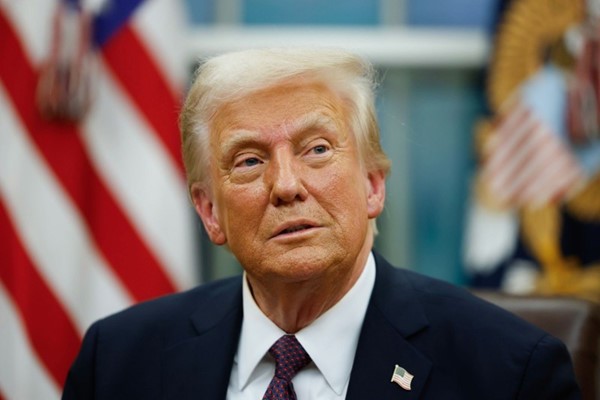
Trump threatens to launch larger attacks on Iran if it does not commit to a real agreement, while NATO expresses disappointment in his stance, and Pakistan responds to negotiations with a public holiday.
Translated by Alqyas from Al-Anba — Original source
Amid anticipation for the start of negotiations between the United States and Iran, hosted by the Pakistani capital Islamabad, U.S. President Donald Trump threatened to carry out larger and more powerful attacks on Iran if it does not comply with the “real” terms of a ceasefire agreement between the two sides, including ensuring the safe passage of global energy supplies through the Strait of Hormuz.
Trump wrote on his platform, Truth Social, that “all U.S. ships, aircraft, military personnel, as well as additional ammunition and weapons, and everything appropriate and necessary to inflict a crushing defeat on the greatly weakened enemy, will remain in their positions inside and around Iran until full compliance with the genuine agreement reached is achieved.”
He added, warning Tehran, “And if for any reason this compliance does not occur, which is highly unlikely, then the firing will begin,” stressing that this time it would be “on a larger, better, and more powerful scale than any human has ever witnessed.”
He affirmed that the agreement with Iran regarding its not possessing nuclear weapons “was reached a long time ago, despite all the false rhetoric claiming otherwise, as well as the agreement that the Strait of Hormuz would remain open and secure.”
In this context, NATO Secretary General Mark Rutte said yesterday that the U.S. president feels “clear disappointment” toward many alliance countries due to their stance on the U.S. war against Iran, as allies avoided direct engagement in the conflict.
Rutte told CNN in an interview after meeting Trump at the White House that the meeting took place within the framework of an “open discussion between good friends,” noting that he understands the U.S. president’s position.
However, Rutte said he made it clear to Trump that many European countries have provided support in ways other than direct military engagement, including logistical services, overflight rights, and the use of bases.
When asked whether Trump had indicated the possibility of withdrawing from NATO, Rutte said, “There is disappointment, that is clear, but at the same time he was also listening carefully to my views on what is happening.”
Rutte emphasized that a large part of Europe supports the president when it comes to weakening Iran’s ability to “export chaos.”
Following the meeting, Trump once again criticized NATO.
In a post on the Truth Social platform, he wrote: “NATO was not there when we needed it, and it will not be there if we need it again.” In another post, he added: “None of these people, including the deeply disappointing NATO alliance, understand anything unless they are under pressure.”
White House spokesperson Karoline Leavitt said that Iran had requested a ceasefire, emphasizing that the red lines set by President Trump regarding Iran had not changed. She confirmed that the tough tone of his speech led to an agreement with Tehran. Leavitt revealed that the United States had held talks with China on Iran, but did not specify the details or timing of these discussions.
She noted that Tehran had proposed a “more reasonable” negotiation plan after Washington ignored its initial 10-point plan. She pointed out that Iran was no longer able to distribute weapons to its proxies in the region. She stated that negotiations would focus on the provisions of the U.S. plan and the issue of opening the Strait of Hormuz, stressing that Iran must open the strait “immediately,” and emphasizing that President Trump would hold Iran responsible if it failed to do so.
She reiterated that Lebanon was not part of the ceasefire agreement with Iran, noting that President Trump would continue talks on Lebanon with Israeli Prime Minister Benjamin Netanyahu.
Meanwhile, the European Union, through its spokesperson, announced yesterday its rejection of the idea of imposing fees for transit through the Strait of Hormuz, calling for the preservation of freedom of navigation in this vital waterway. Anwar Anouni stated that “international law enshrines freedom of navigation, meaning no payments or fees of any kind.” He added that “the Strait of Hormuz is, like all other maritime straits, a public good for all humanity… meaning that navigation through it should be free.”
French Foreign Minister Jean-Noël Barrot, in comments to France Inter radio, described imposing fees on navigation in the Strait of Hormuz as “unacceptable,” stressing that it constitutes a violation of international law. Barrot said, “No, this is unacceptable, because freedom of navigation in international waters is a public right, a human right that cannot be restricted by any obstacle or fee.”
Regarding the upcoming negotiations in Islamabad, Pakistani authorities announced a two-day official holiday starting yesterday and continuing today. The notice issued Wednesday evening by the Islamabad Capital Territory administration did not specify the reason for the holiday, but capital authorities often declare holidays or restrictions for security reasons ahead of high-level diplomatic events. According to the notice issued by the Commissioner of Islamabad Capital Territory, the two-day holiday on Thursday and Friday applies only to the capital.
Al Jazeera, citing a Pakistani official, reported that Israel’s attacks on Lebanon constitute a breach of the ceasefire agreement between the United States and Iran, but would not change the negotiation schedule, according to the official.
Meanwhile, the White House announced that the U.S. delegation would be led by Vice President J.D. Vance. In response, the Iranian Foreign Ministry stated that the Iranian delegation would likely be led by Mohammad Bagher Qalibaf, Speaker of the Parliament.
