UK and France Reaffirm Solidarity with GCC to Promote Peace and Security
France and the UK reaffirm their solidarity with the Gulf against Iran and call for de-escalation in the region.
Translated by Alqyas from Al-Anba — Original source
New York, KUNA: The United Kingdom and France affirmed their solidarity with the Gulf Cooperation Council (GCC) and their commitment to enhancing joint cooperation to protect civilians, uphold international law, and preserve peace, security, and stability. This came during a high-level meeting held by the UN Security Council on cooperation between the United Nations and the GCC.
James Carruthers, the UK’s Deputy Permanent Representative to the UN, expressed his country’s unequivocal and strongest condemnation of Iran’s culpable attacks against GCC member states and countries in the region. He reaffirmed that the UK stands in solidarity with all GCC states as they exercise their inherent right to defend their sovereignty and protect their citizens, reiterating “our strong condemnation of the unacceptable Iranian attempts to close the Strait of Hormuz.”
Carruthers praised the GCC countries for their constructive diplomatic efforts, particularly their effective role in mediation and providing humanitarian assistance. He also affirmed that the UK remains steadfast in its commitment to work with the GCC, the United Nations, and all Council members to protect civilians, uphold international law, and promote peace, security, and stability.
For his part, France’s Ambassador to the UN, Jérôme Boniface, stated that “this war has been prolonged longer than it should have been,” calling for de-escalation and an end to attacks targeting civilians and civilian infrastructure across the region. Boniface placed “primary responsibility for the current escalation” on Iran.
Kuwait officials have chosen a strategy that harms regional stability by expanding the conflict to include Lebanon. They emphasized that it is unacceptable for Iran to hold a strategic maritime corridor hostage, as the disruption of traffic in the Strait of Hormuz disrupts supply chains, with severe consequences for the global economy. The French ambassador stressed that cooperation between the United Nations and the Gulf Cooperation Council (GCC) should be strengthened to safeguard maritime security, particularly in strategic sea lanes.
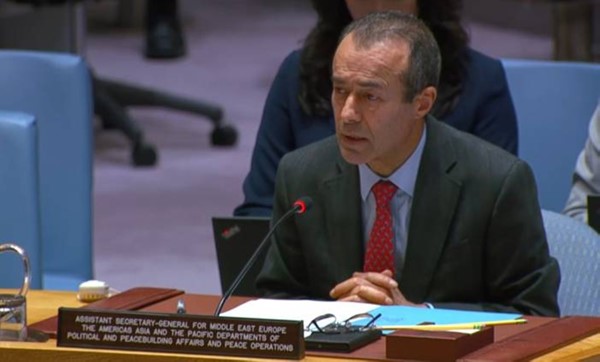
In a related development, Khalid Khayari, the UN Under-Secretary-General for the Middle East, Asia, and the Pacific, affirmed that partnership with regional and sub-regional organizations such as the GCC is “indispensable,” as it constitutes a vital part of collective efforts to enhance peace, security, and stability at the regional level. Speaking during his briefing to the UN Security Council, Khayari stated that the Middle East “stands on the edge of a dangerous abyss,” reiterating the UN’s condemnation of Iran’s blatant aggressions against GCC countries and Jordan. He stressed the urgent need to halt hostilities immediately and for all parties to step back from the brink, noting that the international system is fully mobilized to mitigate the consequences of this escalating conflict.
Khayari added that the continued escalation underscores the urgent need for coordinated multilateral action, highlighting that strengthening cooperation between the UN and the GCC is “imperative.” He warned that while the current war dominates international attention, conflicts, including those in other parts of the Middle East, continue relentlessly. In this regard, he stated that in the occupied Palestinian territory, consolidating the ceasefire in Gaza and advancing the implementation of Security Council Resolution 2803 (2025) remain urgent priorities. He emphasized the necessity of protecting the territorial, political, and institutional integrity of the occupied Palestinian territory, noting that “progress in Gaza cannot be pursued in isolation from the broader context affecting the entire Palestinian people.”
Khayari also addressed the support provided by the GCC, describing it as a pivotal factor in mobilizing the political attention and resources needed for humanitarian response and early recovery efforts. The UN official reiterated the UN’s commitment to deepening its partnership with the GCC, stating that this is not only timely but also essential.
