Gulf and Arab welcome for UN Security Council decision condemning Iranian attacks on regional countries
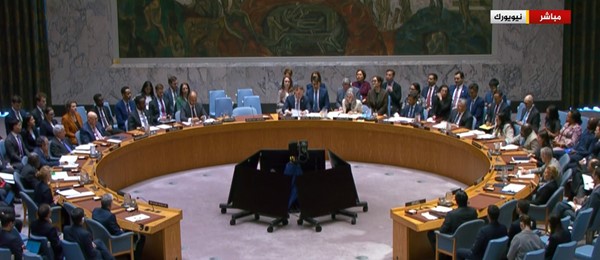
Gulf and Jordanian states expressed their welcome for the UN Security Council decision condemning Iranian attacks on regional countries.
Translated by Alqyas from Al-Anba — Original source
New York – Agencies: The Saudi Ministry of Foreign Affairs expressed the Kingdom’s welcome for the adoption of United Nations Security Council Resolution 2817, which was presented by Saudi Arabia, the Kingdom of Bahrain, the State of Qatar, the Sultanate of Oman, the State of Kuwait, and the Hashemite Kingdom of Jordan. The resolution condemns in the strongest terms the vile attacks launched by the Islamic Republic of Iran against the territories of the Gulf states and Jordan, and determines that these acts constitute a violation of international law and a serious threat to international peace and security.
In a statement, the Saudi Foreign Ministry welcomed the resolution’s contents, including the condemnation of attacks on residential areas and the targeting of civilian objects, as well as the casualties among civilians and damage to civilian buildings caused by these attacks, and expressed solidarity with these countries and their peoples.
The Saudi Foreign Ministry pointed to the international support the resolution received and the international condemnations of these brazen Iranian attacks, calling for their immediate cessation without conditions, and for halting any provocation or threat to neighboring states, including the use of proxies.
The Kingdom affirmed the contents of the resolution and its full right to take measures that ensure the protection of its security, sovereignty, and territorial integrity, and to deter aggression, as recognized under Article 51 of the UN Charter.
For its part, the State of Qatar welcomed the adoption of the resolution by the UN Security Council and its emphasis on respecting the sovereignty and territorial integrity of these states, rejecting the targeting of civilians and vital facilities.
According to the Qatari News Agency (QNA), the Qatari Ministry of Foreign Affairs stressed in a statement the necessity of immediately halting Iranian attacks to spare the region the risks of escalation and to enhance international peace and security. The ministry affirmed that the issuance of the resolution reflects the broad international rejection of Iranian aggressions that violate the sovereignty of these states and contravene international law and the UN Charter.
The ministry renewed Qatar’s call for an immediate cessation of any escalatory actions, a return to the dialogue table, the primacy of reason and wisdom, and efforts to contain the crisis in a manner that preserves regional security, safeguards the interests of its peoples, and prevents sliding into broader confrontations.
The Secretary-General of the Gulf Cooperation Council (GCC), Jassem Mohamed Al-Bedawi, also welcomed the resolution, affirming that this international condemnation, achieved with unprecedented global consensus, is a glaring indication of Iran’s violation of international laws, norms, and charters by targeting civilians, civilian objects, and infrastructure in GCC states and Jordan.
According to the Saudi Press Agency (SPA), the Secretary-General explained that the adoption of the resolution by 136 countries demonstrates the international community’s firm belief in the serious violation represented by Iranian aggressions against the sovereignty of GCC states and Jordan, and their legal right to respond in accordance with Article 51 of the UN Charter, which guarantees the right of individual and collective self-defense in the event of aggression, and to take all measures that preserve their sovereignty, security, and stability.
He clarified that the Security Council resolution affirmed its strong support for the territorial integrity of all GCC states and Jordan, as well as their sovereignty and political independence. The resolution also highlighted the importance of the Gulf region for international peace and security and its vital role in global economic stability, while reaffirming the right of navigation for ships heading to and from all ports and facilities of coastal states that are not parties to hostilities. He expressed his appreciation to the representatives of GCC states and Jordan for presenting this resolution and mobilizing international efforts to secure its adoption.
For his part, the Secretary-General of the Arab League, Ahmed
Abu Ghazaleh stated that the adoption by the UN Security Council of a resolution condemning Iranian attacks on Gulf states and Jordan embodies full global solidarity with the Arab position. This came during a telephone conversation between Abu Ghazaleh and Bahraini Foreign Minister Dr. Abdulatif bin Rashid Al Zayani, during which he praised the important role played by the Kingdom of Bahrain, as the Arab member of the Security Council, in rallying support for the international draft resolution, according to a statement from the Arab League.
Abu Ghazaleh condemned the continuation of Iranian attacks on several Arab countries, saying they “reflect a determination to engage in miscalculations, a lack of direction, and a failure to appreciate the consequences of this reckless policy on Iran’s relations with its neighbors.” He reiterated that attacking sovereign states cannot be justified under any pretext or excuse, and that Arab states refuse to allow their territories and resources to become arenas for settling scores.
Abu Ghazaleh considered that the adoption of the international resolution by a majority of 13 votes expresses broad international rejection of Iranian attacks on Arab states and confirms clear solidarity with the Arab position.
The UN Security Council had previously voted in favor of a draft resolution presented by the Gulf Cooperation Council (GCC) states and Jordan, condemning Iranian attacks on GCC countries, with 13 votes in favor, two abstentions, and no opposition.
The resolution, numbered 2817/2026, included several demands, foremost among them: the strongest condemnation of Iran’s horrific attacks, which constitute a violation of international law and a serious threat to international peace and security; a call for an end to Iranian hostile acts and provocations by Tehran; and a demand to denounce Iran’s deliberate targeting of innocent civilians and civilian objects, as well as attacks and threats against the Strait of Hormuz and the international maritime navigation system.
During the Security Council session, the Permanent Representative of the Kingdom of Bahrain to the UN, Ambassador Jamal Al-Ruwaili, emphasized the necessity of respecting the security and safety of international maritime navigation. He stated that “our region has witnessed a series of serious Iranian attacks,” noting that Iranian aggression targeted civilian facilities in GCC states and Jordan, resulting in civilian casualties. He stressed that “GCC states have the full right to take whatever is necessary to defend themselves.”
The Kuwaiti Ministry of Foreign Affairs expressed Kuwait’s welcome of the Security Council’s adoption of Resolution 2817, which condemns Iranian attacks targeting GCC states and the Hashemite Kingdom of Jordan, and which reaffirms respect for state sovereignty and territorial integrity, as well as the rejection of targeting civilians and vital infrastructure.
The Ministry stated in a press release that the Security Council’s adoption of this resolution represents an important step toward enhancing stability in the region, and called for full commitment to its provisions and efforts to prevent further escalation in the region, thereby contributing to consolidating regional and international security and stability.
Kuwait expressed appreciation for the efforts made in the Security Council to adopt this resolution, particularly by the sister Kingdom of Bahrain, which presented the resolution on behalf of the GCC states and the Hashemite Kingdom of Jordan, reflecting the Council’s commitment to fulfilling its responsibilities in safeguarding international peace and security and reinforcing the principles of international law and the UN Charter.
The Ministry also expressed Kuwait’s gratitude to the UN member states that sponsored Resolution 2817 in solidarity with the GCC states and the Hashemite Kingdom of Jordan.
On the other hand, the UN Security Council voted against a draft resolution submitted by Russia concerning the war against Iran, with two members opposing it, including a veto by the United States, four members in favor, and nine abstaining.
Before the vote on the Russian draft resolution, US UN Ambassador Mike Waltz told the Council that: “The Iranian regime threatens international peace and security.” Waltz condemned Iran’s attacks on civilians in neighboring countries, saying it is working to spread chaos in the region. He added: “We condemn Iran’s targeting of civilian infrastructure in Gulf states and several other countries in the region.”
For her part, Russia’s Deputy Permanent Representative to the UN, Anna Vesyelnitskaya, said that the draft resolution submitted by her country calls for a ceasefire in the Middle East and condemns attacks on civilians. Vesyelnitskaya added in her statement: “We hope that diplomatic options have not yet been exhausted, and that the relevant parties demonstrate the necessary political will and reject further violence.”
