SDF signs ceasefire agreement and fully integrates into the government
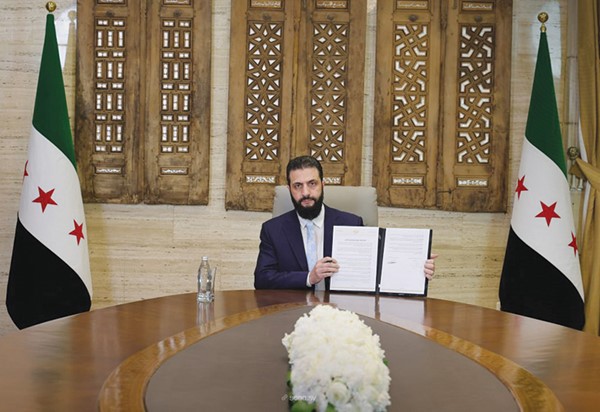
The Syrian president signed a ceasefire agreement and the integration of the SDF into the government, following a popular uprising in Raqqa, Al-Hasakah, and Deir ez-Zor, and the withdrawal of SDF forces from areas west of the Euphrates.
Translated by Alqyas from Al-Anba — Original source
Syrian President Ahmad al-Sharaa signed a comprehensive and immediate ceasefire agreement across all fronts and contact points between the Syrian government forces and the Syrian Democratic Forces (SDF), alongside the withdrawal of all SDF military formations to the east of the Euphrates region as a preliminary step for redeployment. SDF leader Mazloum Abdi is expected to travel to Damascus today to sign the agreement, after weather conditions prevented him from doing so yesterday.
The agreement includes integrating all civilian institutions affiliated with the SDF into Syrian state institutions and administrative structures, and merging all SDF military and security elements into the organizational frameworks of Syria’s Ministries of Defense and Interior on an individual basis, following necessary security vetting.
The agreement came after the Syrian army tightened its grip on areas west of the Euphrates, while tribal forces and local residents in Deir ez-Zor, Al-Hasakah, and Raqqa launched what authorities described as a “popular uprising” that expelled the Kurdish Syrian Democratic Forces (SDF) from numerous cities and strategic sites in the three governorates, particularly oil and gas fields and the Euphrates Dam.
In Raqqa, Arab tribes clashed with SDF forces. The Syrian Al-Ikhbariya channel reported that locals seized the Military Security headquarters and expelled SDF elements from it. The Al-Thawra Al-Suriya newspaper confirmed that the “popular uprising” took control of Al-Mashlab, one of the largest neighborhoods in Raqqa.
Al-Jazeera channel quoted sources from Syrian tribal forces as saying that several SDF members from Raqqa had defected from the group, and that there was a popular movement among the city’s residents against the SDF.
It announced that it would hand over the entire city to the government for administration after expelling the forces of the Syrian Democratic Forces (SDF) from it. The Syrian Arab News Agency (SANA) reported that at least two civilians were killed by SDF gunfire in Al-Wadi Street and near the Al-Na’eem roundabout in the city of Raqqa. Al-Ishraiq reported, citing Al Jazeera, that “snipers from SDF remnants targeted civilians in several neighborhoods in Raqqa.” The Directorate of Media for Raqqa Governorate, according to SANA, stated that “Raqqa city has been completely cut off from water supplies” due to the SDF’s destruction of water infrastructure. Meanwhile, Al-Ikhbariya reported that a local source confirmed “the defection of more than 400 SDF elements in Raqqa and their joining the popular uprising.”
Syrian authorities had previously announced the deployment of security forces in the strategic city of Tabqa in Raqqa Governorate, and their control over the adjacent Euphrates Dam, the country’s largest dam and Syria’s biggest hydropower facility. SANA reported that Internal Security Forces had deployed in the city following the Syrian Arab Army’s expulsion of the Kurdistan Workers’ Party (PKK) militia from the city. Interior Ministry spokesperson Nour al-Din al-Baba stated that Tabqa is witnessing a gradual return to normal life, amid an atmosphere of joy and relief among residents, and the beginning of the return of civilians who were forced to leave the city in recent weeks. He emphasized that the situation is improving.
Al-Baba noted that government forces are operating within a broad popular base, clarifying that residents of liberated areas form a fundamental pillar and direct support for the ministries of Interior and Defense. He pointed out that the popular uprising against the SDF significantly facilitated the operations of government forces, particularly in Raqqa Governorate, where the area stretching from Deir Haffar to Tabqa city has been secured.
The Syrian government condemned the executions of prisoners and detainees by the PKK and SDF in Tabqa prison prior to their withdrawal, affirming that the execution of prisoners and detainees constitutes a complete war crime under the Geneva Conventions.
In Hasaka Governorate, Al Jazeera quoted a source from the Syrian Tribes Forces stating that areas south of Hasaka, from Al-Suwayda to Ashadadi, have been cleared of SDF forces. It announced the “liberation of Ashadadi and its three districts and its surroundings in southern Hasaka countryside,” as well as control over the Jibsa gas plant east of Ashadadi. It also announced the defection of Arab tribal members from the SDF in Ashadadi, with remaining elements withdrawing to Hasaka.
Earlier, the SDF suddenly withdrew at dawn from areas under its control in eastern Deir ez-Zor Governorate, following a statement by tribal leaders in the governorate announcing their support for the Syrian Army and offering cooperation to expel the SDF from the predominantly Arab governorate, which includes Syria’s most prominent oil fields, such as the Al-Omar field (Syria’s largest) and the Tanak oil field, as well as the Conoco gas field, the largest gas field in the country.
Deir ez-Zor Governorate Governor Ghasan al-Sayed Ahmad stated that “the collapse of the SDF in the face of the popular uprising by the people of Deir ez-Zor was rapid,” noting that the uprising reached as far as Markada town on the administrative border with Hasaka Governorate. In interviews with Al-Ikhbariya, the governor confirmed that the governorate has implemented an emergency plan to meet humanitarian needs resulting from clashes with the SDF. The Al-Omar field is Syria’s largest oil field and had been under SDF control since the expulsion of the Islamic State (ISIS) from it in 2017.
The field has served for years as a key base for the US-led international coalition, which provided direct support to the Kurds until they drove the group from its last stronghold in 2019.
Terms of the agreement between the government and the SDF
The ceasefire agreement terms between the government and the SDF include:
- A comprehensive and immediate ceasefire on all fronts and contact points between Syrian government forces and the Syrian Democratic Forces (SDF), alongside the withdrawal of all SDF military formations to the east of the Euphrates region as a preliminary step for redeployment.
- The immediate and full administrative and military handover of the provinces of Deir ez-Zor and Raqqa to the Syrian government. This includes taking over all civil institutions and facilities, issuing immediate decisions to retain current employees within the relevant Syrian state ministries, and the government’s commitment not to target SDF fighters, personnel, or the civil administration in the two provinces.
- Integrating all civil institutions in Al-Hasakah province into Syrian state institutions and administrative structures.
- The Syrian government’s takeover of all border crossings and oil and gas fields in the area, with their protection ensured by regular forces to guarantee the return of resources to the Syrian state.
- Integrating all SDF military and security elements into the structures of the Syrian ministries of Defense and Interior on an “individual” basis, following necessary security vetting, while granting them appropriate military ranks, financial benefits, and logistical provisions, with protection of Kurdish areas’ privacy.
- The SDF leadership commits to not incorporating remnants of the ousted regime into its ranks and to handing over lists of ousted regime officers located in northeastern Syria.
- Issuance of a presidential decree appointing a candidate to serve as governor of Al-Hasakah, as a guarantee for political participation and local representation.
- Clearing the city of Ain al-Arab/Kobani of heavy military displays, forming a security force composed of local residents, and maintaining a local police force administratively subordinate to the Syrian Ministry of Interior.
- Integrating the administration responsible for the Daesh prisoners and camps file, along with the forces tasked with protecting these facilities, with the Syrian government, so that the Syrian government assumes full legal and security responsibility for them.
- Adoption of a list of leadership candidates submitted by the SDF leadership to fill senior military, security, and civil positions within the central state structure, to ensure national partnership.
- Welcoming Presidential Decree No. 13 of 2026, which stipulates recognition of Kurdish cultural and linguistic rights, addressing the rights and civil issues of unregistered individuals, and restoring accumulated property rights from previous contracts.
- The SDF commits to removing all non-Syrian PKK leaders and elements outside the borders of the Syrian Arab Republic to ensure sovereignty and regional stability.
- The Syrian state commits to continuing the fight against terrorism (Daesh) as an active member of the international coalition, coordinating jointly with the United States in this framework to ensure regional security and stability.
- Working toward understandings regarding the safe and dignified return of residents of the Afrin and Sheikh Maqsoud areas to their regions.
