1.64 billion dinar surge in foreign ownership in the First Market over a year
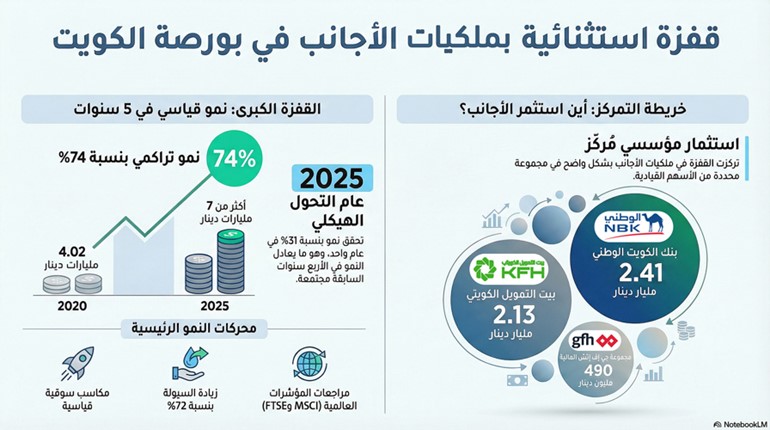
Foreign ownership in the Kuwait First Market rose to 7 billion dinars in 2025, a 31% increase compared to 2024, concentrated in leading stocks such as National Bank of Kuwait and Kuwait Finance House.
Translated by Alqyas from Al-Anba — Original source
Ahmed Maghrabi
With the entry into 2026, foreign ownership in the First Market of the Kuwait Stock Exchange has emerged as one of the most profound indicators of structural transformation in the market’s composition in recent years. This ownership surged from approximately 4.02 billion dinars at the end of 2020 to over 7 billion dinars by the end of 2025.
This increase, which includes growth of approximately 31% in a single year compared to 2024, represents a cumulative growth of nearly 74% over five years. It reflects not merely quantitative expansion, but a structural shift in foreign investor behavior toward institutional concentration within the leading stocks of the First Market.
These figures indicate that the jump recorded in 2025 was not a natural extension of a quiet trajectory, but rather a structural change in foreign investor behavior. On an annual basis, foreign ownership rose by approximately 1.64 billion dinars between 2024 and 2025, representing a growth rate of nearly 31%. This rate is roughly equivalent to the total growth achieved during the entire period from 2020 through the end of 2024. Compared to 2020, the total increase exceeding 3 billion dinars reflects the market’s transition from a phase of “limited concentration” to one of “heavy institutional presence.”
The significance of this jump lies not only in its magnitude, but also in the context in which it occurred. At the end of 2020, foreign ownership in the First Market was distributed across only 20 companies, with a total value of approximately 4.02 billion dinars, during a period when the market was still regaining momentum after years of stagnation.
Over time, and specifically by 2024, ownership had risen to 5.36 billion dinars, representing growth of approximately 33% over four years. This growth was then classified as gradual improvement, reflecting a steady return of confidence. However, 2025 marked the true turning point, as ownership jumped in a single year by a rate nearly equivalent to that achieved over the previous four years. This established the peak of the cumulative trajectory that began in 2020 and ushered in a new phase of foreign concentration in the First Market.
This transformation did not occur in isolation from the market environment that took shape in 2025, which provided fertile ground for raising levels of foreign exposure. The Kuwait Stock Exchange ended the year with market gains exceeding 9.6 billion dinars, pushing the market capitalization to approximately 53.2 billion dinars, up from about 43.5 billion dinars at the end of 2024. Historical levels exceeding 54 billion dinars were recorded during certain periods of the year, levels unseen on trading screens for more than 17 years. This expansion in capitalization enhanced the weight and attractiveness of the Kuwaiti market within the regional investment map, contributing to the reclassification of the market in the eyes of foreign investors from a recovery market to a genuine growth market.
Improved liquidity also directly supported this trajectory. Trading volumes in 2025 rose to approximately 117 billion shares, compared to about 68 billion shares in 2024, representing a 72% increase. Meanwhile, the value of trades reached approximately 26.6 billion dinars. These indicators were not merely numbers; they sent direct messages to foreign investors that the market had become deeper and more capable of absorbing large investment positions.
In addition, periodic and annual reviews of global indices played a pivotal role in accelerating the pace of foreign entry in 2025. The year saw the implementation of 12 revisions to MSCI, FTSE, and S&P indices, which are directly linked to the rebalancing of global fund portfolios. When examining the concentration map, it becomes clear that the jump in foreign ownership was not horizontal or randomly distributed, but was clearly concentrated in a specific group of leading stocks that form the backbone of the First Market.
National Bank of Kuwait tops this map, as the value of foreign ownership in its shares rose from approximately 1.15 billion dinars at the end of 2020 to around 1.83 billion dinars at the end of 2024, before registering a notable jump in 2025 to reach about 2.41 billion dinars. This represents a cumulative growth of nearly 110% over five years, reflecting the stock’s status as the largest vessel for foreign concentration in the First Market.
In second place, Kuwait Finance House stands out as one of the key hubs for foreign concentration. The value of foreign ownership moved from lower levels in 2020 to approximately 1.70 billion dinars at the end of 2024, then continued its rise in 2025 to reach about 2.13 billion dinars. This marks an increase of roughly 430 million dinars within a single year, with a growth rate of approximately 25%, underscoring the sustained appeal of the Islamic banking sector to foreign investors.
Gulf Holding Company (GFH) recorded one of the most prominent relative jumps during the monitored period. The value of foreign ownership rose from relatively modest levels in 2020 to approximately 301.3 million dinars at the end of 2024, before surging in 2025 to nearly 490 million dinars. This reflects an increase of about 190 million dinars, with a growth rate exceeding 60% in one year, indicating the stock’s move to a prominent position within foreign portfolios.
In the telecommunications sector, Zain maintained its position as one of the stocks attracting foreign concentration. The value of foreign ownership rose from lower levels in 2020 to approximately 256.5 million dinars at the end of 2024, then continued to grow in 2025 to reach about 344.7 million dinars, supported by stable cash flows and the expansion of the company’s regional operations.
Kuwait Bourse also witnessed significant expansion in foreign ownership in recent years, benefiting from the operational and developmental momentum experienced by the market. The value of foreign ownership gradually increased alongside rising institutional interest in the stock as a direct reflection of the overall market performance, strengthening its presence on the map of foreign concentration in the First Market, with the value of ownership exceeding 108 million dinars.
In the banking sector as well, Gulf Bank maintained a prominent presence, indicating continued confidence in the stock as a component of foreign banking concentration, with the value of ownership reaching 195.27 million dinars. Additionally, Boubyan Bank saw clear expansion in foreign ownership in recent years, with the value rising from modest levels in 2020 to approximately 223 million dinars by the end of 2025. This marked growth during 2024 and 2025 directly reflects the increasing interest of foreign investors in rapidly growing Islamic banks.
Looking ahead to 2026, additional indicators reinforce this upward trajectory. The Kuwait Bourse’s latest annual review resulted in the upgrade of four new companies to join the First Market Index, raising the number of constituent companies to 38. This update will take effect starting February 8, 2026. This expansion is expected to broaden the base of stocks eligible for foreign concentration and redistribute weights within portfolios linked to global indices, making it likely that foreign ownership will continue to grow this year, starting from a high base rather than from foundational levels.
