Aoun Completes First Year in Baabda.. What Was Achieved in the 'People's Balance Sheet'
President Joseph Aoun completed his first year in Baabda, focusing on de-escalating tensions with Israel, improving relations with Iran, resolving the weapons issue in the South, and signing a petroleum agreement with Qatar and Eni.
Translated by Alqyas from Al-Anba — Original source
Beirut - Naji Charbel and Ahmed Essam Eldin
President Joseph Aoun completed his first year in the Baabda Presidential Palace on Friday, becoming the 14th president since independence and the fourth army commander to assume the country’s highest official office. His predecessor, President General Michel Aoun, entered the presidential palace on October 31, 2016, 26 years after he had removed his Lebanese Army camouflage uniform.
Regarding what has been achieved during the past year and what President Joseph Aoun looks forward to, he shares these insights directly with the public in a televised address on Sunday evening from the state’s official platform, Télé Liban. As for an assessment of his first presidential year from the people’s perspective, one can highlight the president’s dynamism, openness, and his retention of the personal qualities that characterized him as a young man, then as an officer who graduated from the Military Academy, as an army commander, and finally as president of the country. Throughout this journey, the man who bridges the distance with citizens has remained steadfast, guided by the saying “all glory is vanity,” and recalling his modest life, like that of most Lebanese, which has constantly made him realize that people look to him because he understands them better than other officials.
He does not offer empty promises, but rather delivers quick results on the ground by striving to address long-standing intractable problems, starting with the management of state facilities that meet people’s needs and respond to their daily demands.
In his primary role as head of state, President Aoun began his presidential journey with a concept of inclusiveness, firmness, and refusal to back down in the face of difficulties. He succeeded in sparing the country from a new large-scale Israeli war by urging Pope Leo XIV to visit Lebanon (November 30 – December 2, 2025). However, the president treats Israeli threats seriously, recognizing that they await a simple pretext to escalate daily attacks into a full-scale war.
Regarding the confrontation with Israel, President Aoun has moved this sensitive file into a negotiation phase under direct American supervision, with French and United Nations participation through the ceasefire implementation monitoring mechanism (“the Mechanism”). To this end, he met on Friday with the head of the Lebanese negotiating delegation, former Ambassador Simon Karam, and provided him with the necessary directives for the January 17 session.
The President of the Republic also addressed the issue of weapons and the extension of state authority over its territory without a partner, exercising wisdom and firmness, with full coordination with one pillar of the “Shia duo,” Speaker of the Parliament Nabih Berri, and through direct communication with the concerned party, Hezbollah, via his chief advisor, Brigadier General André Rachid. President Aoun had previously announced that many items from his inaugural address to the Parliament as president would be deferred to the second year of his term, which began yesterday, Friday.
The President of the Republic was briefed by a delegation from TotalEnergies, led by Julian Bogey, on the signing of the petroleum agreement between Lebanon and a consortium of QatarEnergy and Italy’s Eni, concerning the launch of exploration activities in offshore Block 8. President Aoun stressed the “necessity of accelerating exploration work within legal frameworks and adopted standards.” The signing ceremony was subsequently held at the Presidential Palace.
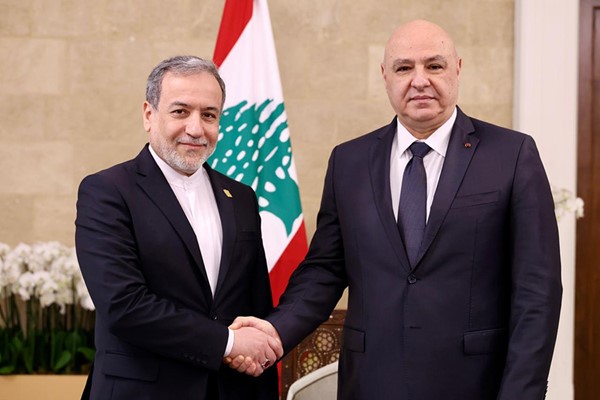
The President of the Republic affirmed to the Minister of Foreign Affairs of the Islamic Republic of Iran, Dr. Abbas Araghchi, during his reception at Baabda Palace, Lebanon’s readiness to enhance economic and trade relations between the two countries for the benefit of both the Lebanese and Iranian peoples, proposing coordination between the relevant ministries, particularly the Ministries of Foreign Affairs and Economy and Trade, through joint committees. President Aoun stressed what he had previously affirmed to Iranian President Masoud Pezeshkian during their meeting in Doha, that Lebanon is keen on establishing the best relations with the Islamic Republic of Iran based on mutual respect, transparency, frankness, and non-interference in the internal affairs of both countries, a stance that remains unchanged. President Aoun pointed out the significant challenges facing both Lebanon and Iran, and wished the friendly Iranian people, at the start of the new year, well-being, security, peace of mind, and better days ahead.
President Aoun asked Minister Araghchi to convey his greetings and best wishes for success and achievement in leading his country and people to safety to President Pezeshkian.
At the outset of the meeting, Minister Araghchi conveyed the Iranian President’s greetings and best wishes for success to President Aoun, recalling their meeting in Doha during the summit held in the wake of the Israeli aggression against Qatar. He noted that his visit to Lebanon falls within the framework of enhancing and developing bilateral relations, particularly in economic and trade sectors, emphasizing the importance of continued consultation, especially on currently raised issues.
Minister Araghchi reiterated his country’s support for Lebanon’s independence, unity, sovereignty, and territorial integrity. He discussed trade and economic relations and the volume of bilateral trade between Lebanon and Iran, as well as the meetings he held in Beirut since his arrival on Thursday, particularly with several Lebanese economists and businessmen to explore ways to develop cooperation given the existing opportunities, especially after overcoming existing obstacles.
On the ground, the pace of Israeli threats of a wider war on Lebanon has decreased, while maintaining graduated escalation against Hezbollah, primarily targeting its positions north of the Litani River and extending to all areas where its centers or sites are located.
The Lebanese Army had announced that the area south of the Litani is now under its control, “with no armed groups present.” The latter phrase sparked anger among a segment of the “Tandem” political environment.
Turning the page on the south of the Litani, now officially under the army’s authority, while continuing the search and detection of potential sites for arms depots or tunnels, attention is shifting to the area north of the Litani, which is more critical, as it would end any international demands or objections, rendering weapons irrelevant in the context of the conflict with Israel. It would also close the chapter on Lebanese and Palestinian weapons outside state authority in the south, which is the most important aspect.
A senior official source told Al-Akhbar: “The army’s preparation of a plan for the north of the Litani area and keeping the door open without deadlines reflects the sensitivity and importance of the step. Two issues can be highlighted here: first, Hezbollah’s refusal to cooperate in the north of the river regarding the disarmament process, either by dismantling or handing over weapons; and second, the Lebanese and international insistence on state monopoly over weapons.”
Here, one can reflect on what Speaker of the Parliament Nabih Berri said: “There is only one state in the world today, and only one emperor.” This statement carries significant weight, implying that the issue must be approached realistically to avoid the horrors of war, and that there is a need to bow to the storm and not open doors for it to uproot everything that can be uprooted.
The source continued: “Regarding the lack of cooperation from ‘Hezbollah’ north of the Litani, there is no cause for concern, as no one seeks confrontation. The army will carry out its mission north of the Litani within the framework of its national responsibilities, as it did in the south, where Hezbollah did not provide it with any maps indicating arms depots or tunnels. These were located through search and follow-up efforts, in cooperation with the international forces (UNIFIL) and the ceasefire monitoring commission. This approach will also apply to the area north of the Litani, which remains under surveillance and the threat of escalation.”
On another front, political sources anticipated that the Lebanese scene would see a movement of envoys in the coming days, as part of efforts to organize a support conference for the army next month, scheduled to take place in the French capital, Paris. This follows the army’s leadership’s explicit declaration of its need for additional support to complete its mission, amid international praise and endorsement of its exceptional work, which brought the area south of the Litani back under the state’s umbrella and protection after more than half a century, specifically since 1969, following the signing of the “Cairo Agreement” with the Palestine Liberation Organization under Egyptian sponsorship, which was annulled in 1984. However, its repercussions persisted until recently, as the army completed its mission south of the Litani, awaiting the commencement of operations north of the river and addressing one of the largest Palestinian refugee camps, Ain al-Hilweh.
The day after Lebanon announced the completion of the first phase of the Lebanese army’s plan north of the Litani, Israel escalated its attacks in the south and the Bekaa, with the Israeli air force launching intense airstrikes on areas in the Taybeh region in the south, villages in the Nabatieh district, and the eastern slopes in the Jurd Birtala area in the Bekaa.
Israeli army spokesperson Avichay Adraee stated that the army struck Hezbollah infrastructure, targeting arms depots and a facility used by Hezbollah to produce combat equipment, which the group used to rebuild its capabilities and rearm itself. The strikes also targeted launch sites, missile platforms, and military buildings.
